

Blog
What Is GEO in SEO and How Does It Work?
Search engine optimization (SEO) has evolved far beyond simply ranking web pages on Google. With the rise of AI-powered search experiences and generative search engines, a new concept is becoming increasingly important: GEO (Generative Engine Optimization).
If you create content for your website, understanding GEO can help you stay visible in the future of search.
What Is GEO in SEO?
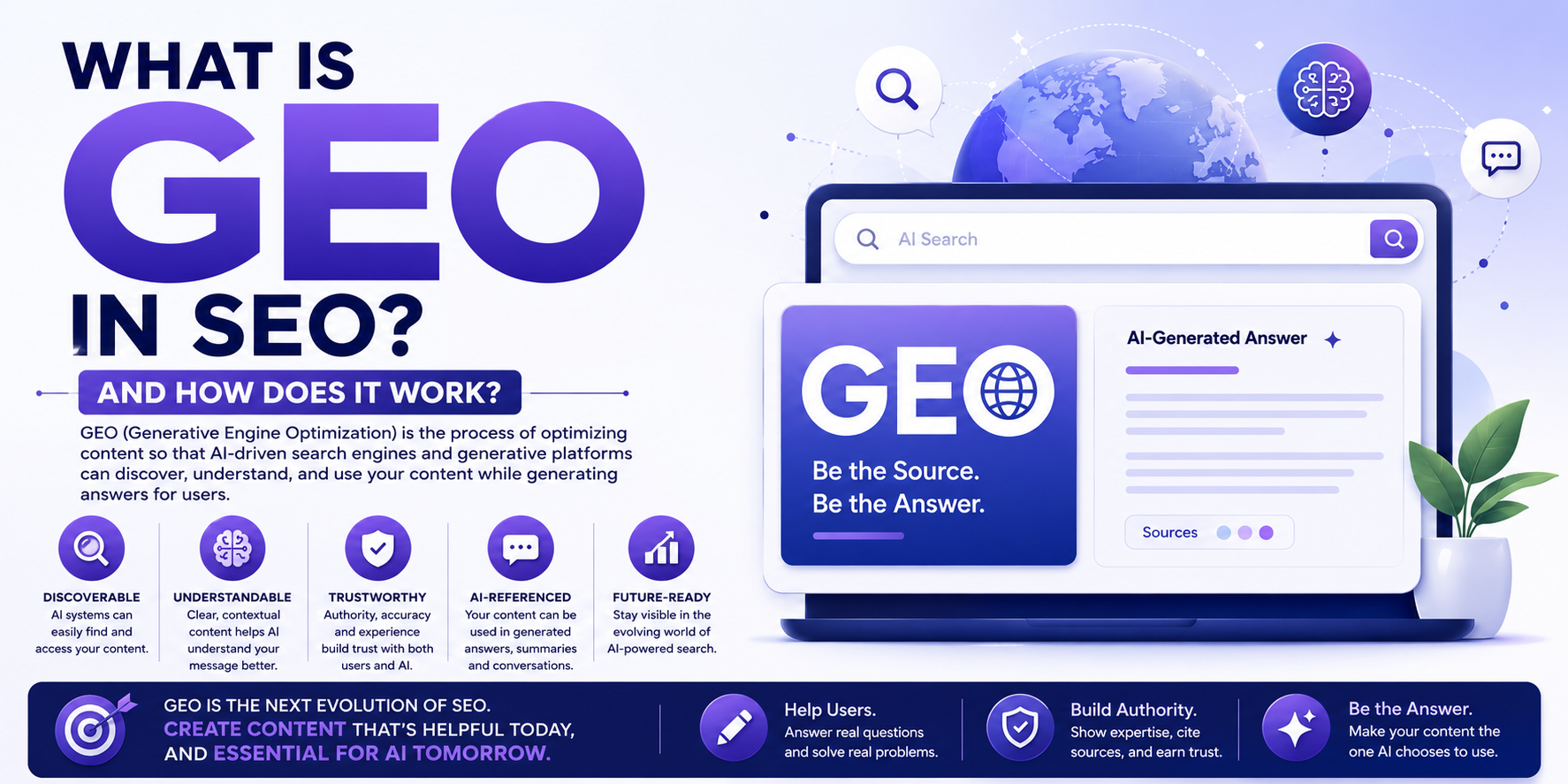
GEO (Generative Engine Optimization) is the process of optimizing content so that AI-driven search engines and generative platforms can discover, understand, and use your content while generating answers for users.
Traditional SEO focuses on improving rankings in search engine result pages (SERPs). GEO focuses on making your content more likely to appear inside AI-generated responses, summaries, and conversational search experiences.
Examples of platforms influencing GEO include:
- AI-powered search experiences
- Conversational search assistants
- Search engines using generative AI summaries
- AI answer engines
In simple words:
SEO → Helps users find your page
GEO → Helps AI understand and reference your content
How GEO Works
Generative engines use advanced AI models to collect information from websites, process it, and generate direct answers.
The GEO process generally works in these stages:
1. Content Discovery
AI systems crawl and access publicly available website content.
Your content becomes easier to discover when:
- Pages are indexed properly
- Site structure is organized
- Content is accessible
2. Content Understanding
Unlike traditional keyword matching, generative systems analyze:
- Meaning
- Context
- User intent
- Entity relationships
This means writing naturally is becoming more important than repeating keywords.
3. Content Selection
AI engines identify sources that appear:
- Helpful
- Trustworthy
- Accurate
- Well-structured
Content with strong topical authority often performs better.
4. Answer Generation
Instead of showing only links, AI may generate summarized responses using information from multiple sources.
Your content may influence the generated answer even if users never click directly to your page.
GEO vs Traditional SEO
| Traditional SEO | GEO |
|---|---|
| Focuses on rankings | Focuses on AI visibility |
| Keyword-heavy | Context and intent-driven |
| Optimizes for search results | Optimizes for generated answers |
| Click-through oriented | Citation and authority oriented |
| Page-level optimization | Knowledge-level optimization |
Key GEO Strategies to Improve Visibility
Create High-Quality, Helpful Content
Write content that directly solves user problems.
Good examples:
- Step-by-step guides
- Detailed explanations
- FAQs
- Expert insights
Structure Content Clearly
Use:
- H1, H2, and H3 headings
- Bullet points
- Tables
- Short paragraphs
Structured content is easier for AI systems to interpret.
Build Topical Authority
Instead of publishing random articles, cover complete topic clusters.
Example for a skincare brand:
- What is Kumkumadi Oil?
- Benefits of Kumkumadi Oil
- How to Use Kumkumadi Oil
- Kumkumadi Oil for Different Skin Types
Use Natural Language
Write the way users actually ask questions.
Instead of:
“Best anti ageing serum India”
Write:
“What ingredients should you look for in an anti-ageing serum?”
Improve EEAT Signals
Google emphasizes:
- Experience
- Expertise
- Authoritativeness
- Trustworthiness
Ways to improve:
- Add author information
- Include sources
- Update content regularly
- Showcase real experience
Add FAQ Sections
FAQs help AI understand question-answer relationships.
Example:
Q: Is GEO replacing SEO?
No. GEO complements traditional SEO rather than replacing it.
Why GEO Matters for Businesses
As search becomes more conversational, businesses that optimize only for traditional rankings may miss visibility opportunities.
GEO helps:
- Increase brand discovery
- Improve authority
- Build trust
- Prepare for AI-first search experiences
For brands in skincare, eCommerce, SaaS, and publishing, GEO can become an important growth strategy.
Final Thoughts
GEO (Generative Engine Optimization) is the next evolution of SEO. Instead of focusing only on rankings, GEO focuses on making your content understandable, trustworthy, and useful for AI-generated search experiences.
The best long-term strategy is simple: create content that answers real user questions better than anyone else.
The future of search is not only about being found—it is about being understood.